
Projects
Cybersecurity of Cyber-Physical Systems
Studied the intersection of cybersecurity and operational technology in manufacturing.
Focusing specifically on workforce education and development through the Department of Energy's Cyber-Manufacturing Institute (CyManII).
We worked to bridge the gap between engineering, IT, and plant maintenance operations and their understanding of systems and security measures required to protect manufacturing industries. Projects were managed using Agile management strategies to optimize output during each sprint.
I worked with engineers from other universities as well as members of various national labs to build custom IT/OT training programs for partnered manufacturing companies.
Machining Diagnostics for Tool Part Wear
The end goal of this project was to build a real time quality analysis tool for machined parts. This was done by collecting and analyzing data on the cut sound, speed, and temperature of the tool bit.
Custom 3D printed sensor holders were used for the experimental apparatus.
Aluminum blocks were milled on a Carbide CNC machine, initial data collection used microphone and accelerometer data on the bit. The data was run through a filter and analyzed in Matlab. The initial step of this project was to manually classify parts as "good" or "bad" using qualitative assessments of the cut.
This was then correlated to the quantitative data from the microphone and accelerometer. Part 2 of the project, used the classifications to predict part quality using real time data from new cuts.
Piezoelectric Sensor Design for Harsh Environments
Micro Electrical Mechanical Systems (MEMS) devices are small sensors that integrate mechanical and electrical elements.
We worked to design a sensor that was able to withstand the high temperatures and radiation inside a nuclear reactor with the goal of effectively measuring temperature and pressure shifts in the reactor.
Using Coventorware Piezomumps software, we laid out a design for a piezoelectric sensor to be fabricated and tested. The modeled sensor was then output to a Matlab model to be simulated for design validity. We
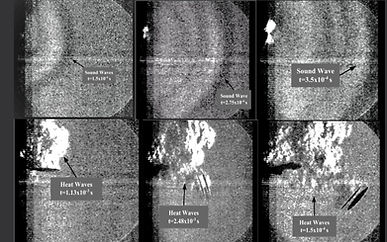
Using Schlieren Photography To Visualize Sound Waves
Schlieren photography is a method used to visualize changes in air density from heat, sound, or shock waves. Some universities and research facilities have specialized equipment for this purpose that smaller universities don't have access to.
We developed a low budget Schlieren photography apparatus to visualize sound waves caused by a party popper. Using a high speed camera, concave mirror, LED light, razer blade, some t-slotted frames and 3D printed parts. We determined it is possible to develop a testing apparatus for under $1,000 (2018) and that small firework party poppers were loud enough to be picked up by the camera.
Stress Analysis of Foot Arch
This project analyzed the location and magnitude of stress applied to the arch of a foot of the same size with different arch types: flat footed, high arch, normal arch. The ligaments, bones and skin were all modeled and given appropriate material properties, keep constant for each model. The project yielded results that showed high arches have the highest stress (as expected), normal arches have the lowest stress concentration, and low arches have lower stress than higher arches, but the stress is concentrated in a different location on the axis examined.

Analysis Stress Applied on Common Dental While Chewing
The purpose of this project was to analyze the stress applied to the gums during chewing for two common two implant designs.
The dental implants were modeled in NX and imported to Abaqus for finite element analysis.
Neighboring teeth and mandible bone were modeled and assembled next to the dental implant for each case. Stresses were applied in a dynamic mode to mimic chewing.

Fluid Deposition on Infant Lung
This project studied the deposition of medicine on the lung of an infant. The deposition was modeling in ANSYS fluent. The purpose of the project was to maximize deposition on the lung walls by optimizing the injection angle and velocity. An experimental apparatus was created post modeling to put test the computational results.
